

What Is a Dead-Cat Bounce?
What a dead-cat bounce is, how it differs from a real reversal, and why telling the two apart in real time is hard.
Last reviewed: November 2026.
A stock falls hard, then rises sharply for a few days. Is the decline over, or is this a trap? A "dead-cat bounce" is the name for the second possibility.
The term
The phrase comes from the grim saying that even a dead cat will bounce if it falls from a great height. In markets, a dead-cat bounce is a temporary rebound within a continuing downtrend. The price recovers some of its losses, then resumes falling, often reaching new lows.
Why bounces happen
Several ordinary forces can produce a short-lived rally after a steep decline:
- Short covering: traders who bet on the decline buy back shares to lock in gains.
- Bargain hunting: some buyers step in because the price looks low relative to recent levels.
- Relief: an extreme move can simply run out of immediate sellers for a few sessions.
None of these forces says anything about whether the underlying reasons for the decline have gone away.
Bounce versus reversal
A true reversal is a lasting change of direction. The difficulty is that the two look identical in the early days:
- Rally size: a dead-cat bounce can be large and fast — and so can the start of a lasting reversal.
- What follows: after a dead-cat bounce, price fails and returns to or below its prior lows; after a lasting reversal, price holds above its prior lows and builds on the move.
- Known when: in both cases, only afterward.
This is the central point: the label is applied after the fact. At the time of the rally, nobody can know which one it is. Any claim of being able to tell them apart in real time deserves skepticism.
Things analysts look at
While no single measure settles the question, people commonly look for evidence over a longer period than a few days:
- Does the price hold above its prior low, or break below it?
- Does the rally come on rising volume, or fade on thin trading? (See Volume, Explained.)
- Does the price recover meaningful ground relative to its decline, or only a small fraction?
- Did anything fundamental change, such as new information about the business, or only the price?
Even a pattern that passes these checks can fail. Waiting for more evidence reduces the risk of mistaking a bounce for a reversal, but it also means giving up part of any move that does turn out to be real. That trade-off is the reason many systematic approaches separate an early signal from a later confirmation: the early signal may mark nothing more than a bounce, so it is treated as a watchlist item rather than a conclusion. The same idea sits behind the two stages described in Trifecta Signals' Methodology: an Early Signal is a candidate, and a signal counts only when additional technical indicators signal a bullish reversal.
Why it matters
The dead-cat bounce is a reminder that a rise after a fall is not proof of a bottom. It is a reason to ask what, specifically, has changed.
Key points
- A dead-cat bounce is a temporary rally inside a continuing decline.
- Bounces and real reversals look alike at the start. The label is only known later.
- Longer evidence windows help, at the cost of missing part of any true move.
Related: Support and Resistance · Volume, Explained · Glossary
Educational material only — not investment advice.
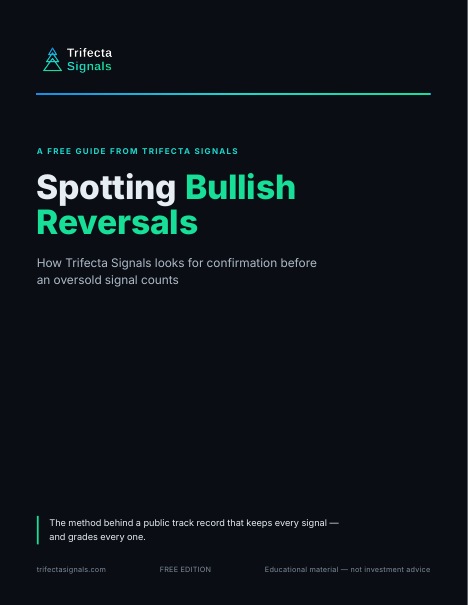
Spotting Bullish Reversals
The short guide to how Trifecta reads an oversold stock: the setup we look for, and why we wait for confirmation before an Early Signal counts. The same method behind the public track record.
Knowing a bounce is not a bottom is step one. The guide is step two — how Trifecta turns a washed-out market into a short list of oversold setups worth watching.
Your guide is on its way to your inbox right away, with the download link inside the email. Signing up also adds you to the Trifecta Weekly Market Review, our Friday newsletter. No card. Along with the guide, you’ll get a short series of follow-up emails from us over the next week, plus the Weekly Market Review. Unsubscribe anytime.
Your guide is on its way
We just sent your guide to — the download link is inside the email, and you’re on the list for Friday’s Weekly Market Review. If you don’t see it within a few minutes, check your spam folder.
Haven’t received it? Add [email protected] and [email protected] to your contacts or safe senders list — that helps your inbox accept both the guide emails and the Friday newsletter.
Didn’t get it? Resend the guide email
Wrong address? Use a different email
You’re signed in, so there’s no email step — the guide is yours to download. Your Weekly Market Review opt-in lives on your dashboard, where you can change it anytime.
Win 30 days of trial access
Take the 5-question Technical Analysis Quiz — get all five right and win 30 days of trial access to the Trifecta Signals stock screener. No card, nothing to cancel. Have an access code instead? Create a free account and add it there — trial access starts the same way.
Five questions, hints included. You sign in only when you claim your trial access.