

How to Read an Earnings Report
A plain-English guide to earnings reports: revenue, EPS, guidance, GAAP vs adjusted figures, and why stocks move on expectations rather than the raw numbers.
Last reviewed: November 2026.
Public companies in the United States report results every quarter, and these reports are among the most common triggers of sharp price moves. Knowing what is in one, and why the headline number often matters less than people expect, helps explain a lot of price action.
The documents
A company typically publishes a press release and holds an earnings call, then files its detailed Form 10-Q (quarterly) or Form 10-K (annual) with the SEC. The filings are free on the SEC's EDGAR database. The press release is the company's summary; the filing is the formal record, with notes on accounting and risks.
The filing is built around three financial statements, and the press release usually highlights only the first:
- Income statement: revenue, expenses, and profit over the period — where the headline numbers come from.
- Balance sheet: what the company owns (assets), what it owes (liabilities), and the difference (equity) at one point in time: cash on hand, debt coming due, working capital.
- Statement of cash flows: cash in and out, grouped into operating, investing, and financing activities — harder to dress up than the income statement, because it tracks bank balances rather than accounting judgments.
Reading the three together matters: a company can report rising profits while its cash shrinks and its debt grows, and the income statement alone would not show it.
The core numbers
- Revenue (sales): the amount recognized for goods and services delivered during the period. Recognized revenue is not always the same as the amount billed: a company can bill a customer before the work is done, and the unearned part sits as deferred revenue until delivery. Revenue shows the size and growth of the business before costs.
- Net income: what is left after all expenses, interest, and taxes.
- Earnings per share (EPS): net income attributable to common shareholders divided by the weighted-average number of shares outstanding during the period. Because share counts change, EPS lets you compare across time.
- Margins: profit as a percentage of revenue (gross, operating, net). Rising or falling margins show whether growth is becoming more or less profitable.
- Cash flow: cash generated by operations. Profits can include non-cash items, so cash flow is a useful cross-check.
A note on share counts and dilution
EPS is a per-share figure, so the share count does real work in it. Companies report basic EPS using the weighted-average shares actually outstanding, and diluted EPS using a wider count that also reflects potential shares from stock options, convertible securities, and similar instruments, where those would reduce EPS.
Share counts also move over time, and the movement can flatter or drag on EPS by itself. Buybacks spread the same profit across fewer shares, so EPS can rise even when total profit is flat; issuing new shares — to raise cash, pay for an acquisition, or cover employee stock compensation — dilutes each share's claim on the same earnings. When EPS grows much faster than net income, a shrinking share count is usually the reason.
GAAP vs. adjusted figures
Companies report results under GAAP (generally accepted accounting principles). Many also publish "adjusted" or "non-GAAP" figures that exclude items management considers one-time, such as restructuring costs or stock-based compensation. Adjusted numbers can be informative, but they are the company's own definition and vary between companies. When comparing, check what was excluded.
Guidance
Many companies also give guidance: their expectations for coming quarters or the full year. Guidance is often what moves the stock most. A company can beat last quarter's estimates and still fall sharply if it lowers its outlook.
Why stocks move on expectations
Analysts publish estimates for revenue and EPS, and the average is called the consensus. By the time results arrive, the price already reflects what the market expects. A stock typically moves on the difference between results and expectations, and on how the report changes expectations for the future.
- Beats estimates, raises guidance: often positive, but not guaranteed if hopes were higher still.
- Beats estimates, lowers guidance: can fall, because the future outlook worsened.
- Misses estimates, outlook steady: can fall modestly, or even rise if fears were worse.
- Misses, cuts guidance: often the kind of shock that produces sharp selloffs.
These are tendencies, not rules. Reactions vary widely.
Earnings and oversold conditions
A sharp earnings-day drop can start an oversold condition, and sometimes the market overreacts. Sometimes it does not: the report may reveal a real, lasting change in the business. That uncertainty is why we describe oversold readings as a starting point for scrutiny, not a conclusion. See Using the Screener.
Key points
- Revenue, EPS, margins, and cash flow each tell a different part of the story.
- The balance sheet and the statement of cash flows sit behind the headline numbers in the 10-Q and 10-K, and they can tell a different story from the income statement.
- Non-GAAP figures are management's own definitions. Check what they exclude.
- Prices respond to results versus expectations, and to guidance, more than to the raw numbers.
Related: Technical Analysis, Explained · Volume, Explained · Glossary
Educational material only — not investment advice.
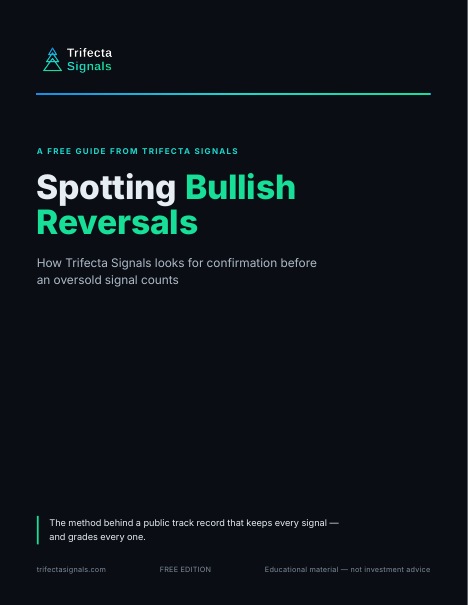
Spotting Bullish Reversals
The short guide to how Trifecta reads an oversold stock: the setup we look for, and why we wait for confirmation before an Early Signal counts. The same method behind the public track record.
Reading the report behind the headline is step one. The guide is step two — how Trifecta turns a washed-out market into a short list of oversold setups worth watching.
Your guide is on its way to your inbox right away, with the download link inside the email. Signing up also adds you to the Trifecta Weekly Market Review, our Friday newsletter. No card. Along with the guide, you’ll get a short series of follow-up emails from us over the next week, plus the Weekly Market Review. Unsubscribe anytime.
Your guide is on its way
We just sent your guide to — the download link is inside the email, and you’re on the list for Friday’s Weekly Market Review. If you don’t see it within a few minutes, check your spam folder.
Haven’t received it? Add [email protected] and [email protected] to your contacts or safe senders list — that helps your inbox accept both the guide emails and the Friday newsletter.
Didn’t get it? Resend the guide email
Wrong address? Use a different email
You’re signed in, so there’s no email step — the guide is yours to download. Your Weekly Market Review opt-in lives on your dashboard, where you can change it anytime.
Win 30 days of trial access
Take the 5-question Technical Analysis Quiz — get all five right and win 30 days of trial access to the Trifecta Signals stock screener. No card, nothing to cancel. Have an access code instead? Create a free account and add it there — trial access starts the same way.
Five questions, hints included. You sign in only when you claim your trial access.