

Free calendar · Company earnings
Stock Earnings Calendar
Every US-listed company's earnings report date, in one market earnings calendar — organized by week and then by month, with before-open and after-close times and analyst EPS estimates where they exist. No paywall, no account, no clutter: just this week's earnings and everything coming after, each ticker linked to its Trifecta Signals page.
773 upcoming reports · Nov 17, 2026 – Feb 15, 2027
No reports match that search in the next three months. Check the spelling, or try the ticker symbol.
Most watched this week
The names most likely to move the market this week. Tap any pill for the details and a link to its stock page.
Earnings this week
The full company earnings calendar for the week of Nov 16–20, 2026 — 247 reports, day by day. Days lead with their count — tap one to expand it. Inside, each day splits into before the open and after the close, most-watched names first, and tapping any company tile opens its report details and stock-page link.
Before the open · 27 companies
After the close · 12 companies
Time to be announced · 17 companies
Before the open · 20 companies
After the close · 16 companies
Time to be announced · 70 companies
Before the open · 21 companies
After the close · 15 companies
Time to be announced · 26 companies
Before the open · 8 companies
Time to be announced · 14 companies
The weeks ahead
Same calendar, looking forward — week by week through the week of Dec 7, then month by month into Feb 2027.
Week of Nov 23Nov 23–29 · 96 earnings
Before the open · 2 companies
After the close · 15 companies
Time to be announced · 9 companies
Before the open · 21 companies
After the close · 10 companies
Time to be announced · 12 companies
Before the open · 6 companies
After the close · 1 companies
Time to be announced · 14 companies
Before the open · 1 companies
Time to be announced · 5 companies
Week of Nov 30Nov 30–6 · 87 earnings
Before the open · 2 companies
After the close · 1 companies
After the close · 11 companies
Time to be announced · 5 companies
Before the open · 6 companies
After the close · 7 companies
Time to be announced · 14 companies
Before the open · 11 companies
After the close · 8 companies
Time to be announced · 18 companies
Before the open · 1 companies
Time to be announced · 3 companies
Week of Dec 7Dec 7–13 · 91 earnings
Before the open · 1 companies
After the close · 1 companies
Time to be announced · 4 companies
Before the open · 5 companies
After the close · 2 companies
Time to be announced · 26 companies
After the close · 2 companies
Time to be announced · 18 companies
Before the open · 1 companies
After the close · 2 companies
Time to be announced · 21 companies
Time to be announced · 8 companies
December 2026 earnings
January 2027 earnings
February 2027 earnings
Take the Technical Analysis Quiz
Five questions drawn from our free Learn guides — dead-cat bounces, golden crosses, drawdowns, beta and RSI. Get all 5 right to get 30 days of trial access to the Trifecta Signals stock screener.
Take the quizHow to read this earnings calendar
Before open vs. after close. Every report lands in one of two windows. Before open (pre-market) means the numbers arrive ahead of the 9:30 AM ET opening bell, so the stock has the full session to react. After close (post-market) means they arrive after 4:00 PM ET — the first reaction happens in after-hours trading, and the bigger one usually comes at the next morning's open. A smaller group of companies never announces a session in advance; those rows are marked Time TBA.
The EPS estimate. Where you see an estimate, it is the consensus forecast — the average of the earnings-per-share predictions from the analysts who cover the company, for the quarter being reported. The gap between the actual print and that number is the “beat” or “miss” in the headlines. Treat it as the market's expectation, not a promise: a company can beat the estimate and still fall if its outlook disappoints. A blank estimate just means too few analysts cover the stock for a consensus to exist — common with small caps.
Confirmed vs. tentative dates. Some dates on this calendar have been officially announced by the company; others are projected from its past reporting pattern and firm up as the quarter approaches. As a rule, the closer a date is, the more likely it is confirmed — and the further out it sits, the more likely it is to move. Before you plan around any single date, confirm it on the company's investor relations page.
Why earnings dates move stocks
Earnings day is when expectations meet reality, four times a year. A company can grow revenue, beat the EPS estimate, and still drop sharply if its guidance for next quarter comes in light — and a company that “misses” can rally if the miss was feared to be worse. What moves the price is rarely the number itself; it is the number relative to what was expected, plus what management says about what comes next.
That is why the calendar matters even if you never trade a report. Volatility clusters around earnings: options get expensive into the print, gaps at the open are common, and a stock you have been watching for an oversold setup can reprice overnight. Knowing a report is coming — and whether it lands before the open or after the close — is basic risk awareness. Our Learn guide How to Read an Earnings Report walks through the release itself, Volatility and Beta explains why some stocks swing so much harder than others, and Volume Explained covers the surge in trading that follows a print.
Earnings season, explained
Most US companies report on calendar quarters, so reports arrive in waves in the weeks after each quarter ends — roughly mid-January, mid-April, mid-July and mid-October, each running four to six weeks. The big banks traditionally open each season, and the mega-cap technology names near its peak are what most people mean by “earnings week.” At the height of a wave, this calendar can list well over a hundred reports in a single day.
Between waves it thins out — but it never empties. Retailers mostly run February fiscal years, so names like Walmart and Target report in what looks like the off-season, and plenty of companies keep non-calendar fiscal years. The practical takeaway: check the calendar before assuming a quiet week, because an “off-season” report from a widely held name can still move an index.
How the dates are sourced
The dates, sessions and EPS estimates on this page are compiled from Alpha Vantage's market earnings calendar feed and refreshed daily, covering every US-listed company with a report scheduled in the next three months. Refreshing daily matters: companies do reschedule — for audits running long, holidays, or simple calendar housekeeping — and a stale calendar is worse than none. The “last updated” stamp at the top of the page tells you exactly how fresh this copy is.
One honest limitation: no third-party feed is the source of truth. Companies occasionally move a date before the feeds catch up, and tentative dates are estimates by construction. Before making any decision that depends on a report date, confirm it on the company's own investor relations page.
Frequently asked questions
Which companies report earnings this week?
Every US-listed company scheduled to report is in the calendar above, grouped by day and split into before-open and after-close releases. For the week of Nov 16, 2026 that is 247 reports, including NVIDIA on Tuesday, Nov 17, Home Depot on Tuesday, Nov 17, Walt Disney on Tuesday, Nov 17, Target on Wednesday, Nov 18. Use the search box at the top of the calendar to jump straight to a company.
How do I find a company's earnings date?
Type the company name or ticker into the search box at the top of this page — the calendar filters as you type. You can also open the company's page on Trifecta Signals by tapping its ticker anywhere in the calendar. If a company does not appear, it has no report scheduled in the next three months, or its date has not been set yet.
What time do earnings reports come out?
Almost all reports land in one of two windows: before the open (pre-market, ahead of the 9:30 AM ET opening bell) or after the close (post-market, after 4:00 PM ET). Before-open reports give the stock a full session to react; after-close reports are digested in after-hours trading and at the next morning's open. Some companies — often smaller ones — do not announce a session in advance; those are marked “Time TBA” here.
What does the EPS estimate mean?
It is the consensus forecast: the average of the earnings-per-share predictions made by the analysts who follow the company, for the quarter being reported. When the actual number prints, the gap between it and the estimate is the “beat” or “miss” that headlines quote. The estimate is a forecast, not a promise — and a blank estimate simply means too few analysts cover the company for a meaningful consensus.
Why did a company's earnings date change?
Dates move more often than most people expect. Companies reschedule for ordinary reasons — an audit running long, a holiday, a clash with an investor event — and dates that sit several weeks out are frequently tentative, projected from the company's past reporting pattern rather than officially announced. As a report gets closer, the company usually confirms a firm date. Always check the company's investor relations page before acting on a date.
How far in advance are earnings dates known?
Most companies confirm a date two to four weeks before they report. This calendar looks three months ahead: dates in the next few weeks are mostly confirmed, while dates one to three months out lean tentative and are the most likely to shift. The calendar is refreshed daily so changes show up as they are published.
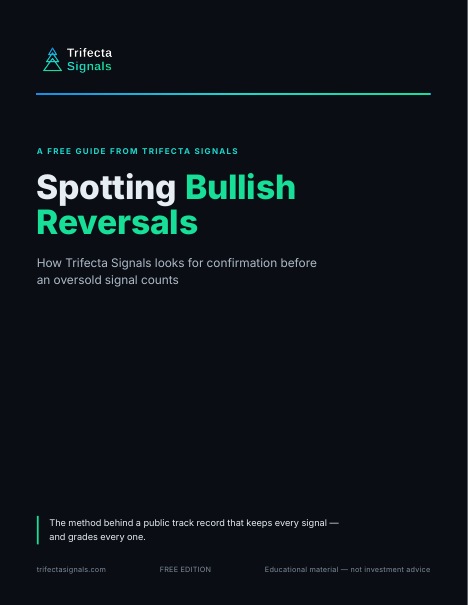
Spotting Bullish Reversals
The short guide to how Trifecta reads an oversold stock: the setup we look for, and why we wait for confirmation before an Early Signal counts. The same method behind the public track record.
Earnings week is when oversold setups reprice fastest. The guide is how Trifecta reads them — the setup we look for, and why confirmation has to come before a signal counts.
Your guide is on its way to your inbox right away, with the download link inside the email. Signing up also adds you to the Trifecta Weekly Market Review, our Friday newsletter. No card. Along with the guide, you’ll get a short series of follow-up emails from us over the next week, plus the Weekly Market Review. Unsubscribe anytime.
Your guide is on its way
We just sent your guide to — the download link is inside the email, and you’re on the list for Friday’s Weekly Market Review. If you don’t see it within a few minutes, check your spam folder.
Haven’t received it? Add [email protected] and [email protected] to your contacts or safe senders list — that helps your inbox accept both the guide emails and the Friday newsletter.
Didn’t get it? Resend the guide email
Wrong address? Use a different email
You’re signed in, so there’s no email step — the guide is yours to download. Your Weekly Market Review opt-in lives on your dashboard, where you can change it anytime.
More free resources
Data: Alpha Vantage earnings calendar (3-month horizon), pulled and refreshed daily. EPS estimates are analyst consensus figures as published in that feed; a blank estimate means no meaningful consensus exists. Company logos are loaded from a public favicon service and remain the trademarks of their owners, shown for identification only.